how to make acorn flour
An Autumn scene: I kneel on the hard ground, still warm from the autumn sun, and finish filling my basket with acorns. I lift my head and look up warily, for acorns have the habit of falling on my head from time to time, calling on me to be present. Calling on me to appreciate the gift. I do, I really do, and I hope the oaks know that.

Worldwide, there are about 600 species of oak (genus Quercus). Many species can be found here in the Iberian Peninsula, from the perennial holm oak and cork oak (which occurs solely here in the Mediterranean region) to deciduous species like pedunculate oak and Pyrenean oak.
With its majestic size, long lifespans, and hard wood, it’s no wonder this tree has been revered through generations and peoples. In Europe, many dwellers of this soil have imbued the oak tree with magic — cultures like the Celts and Germanic tribes and civilizations such as Greco-Romans. Oaks groves have been places of worship, places where gods appeared to ordinary folks, places of divination and dandromancy, places of deep pulsing magic.
But symbolism alone doesn’t fill hungry bellies, and here, oaks performed their roles dutifully. Because oak acorns have been feeding people since prehistorical times and represented a significant portion of the local diet. That is, until the advent of modern agriculture, with its commodification of processes and simplification of diets (but I won’t dwell on that today!). Acorns have fed centuries of meals, breads, and fermented drinks. Acorns have, quite literally, built up the bodies of our ancestors in these lands. However, with its loss of popularity, acorns are now primarily used to feed pigs. What a loss for us, what a win for pigs!
Acorns are rich. Acorns are nutritious. Acorns are, well, free. And, like most wild foods, they represent a connection to the landscape that is worth nurturing as part of a reciprocal relationship between other-than-human and human species. As I like to say, eat the landscape, be the landscape.

A few years ago, I wrote a post here about making acorn flour. However, I’ve revisited and refined this process over the last few years, so consider this an updated version of said post.
And if this is the first time you’re reading about acorn flour, welcome, welcome, I’m so glad you’re here! Let’s do this.

The process
Harvest the acorns
I usually collect the ripe acorns from the ground up, from different species of oak we have on the hill. If you live in an area with squirrels and forming an allegiance with them isn’t possible, you can collect ripening acorns from the tree and leave them to brown indoors, inside a paper bag.
Here’s a fun fact: it takes about 1,5 kg (3.3 lbs) of whole , unsorted acorns to get roughly 300g (0.67 lbs) of flour, knowing that a small quantity of flour gets lost during the process ahead.
Sort the acorns
Many acorns will have been feasted on by small creatures or be rotten, and you don’t want any of those bad nuts. Simply toss your harvest into a bucket of water and discard any that float.
Shell them
I find this to be the most tedious part. I’ve tried different methods over the years, such as giving them a quick roast in the oven to burst the shells (which turned out to make it more difficult, since the shells lose their flexibility) or cracking them with a stone or hammer (which simply makes a mess), and landed on the simple, but most boring method of all: sitting down with a knife and peeling them away. You can also experiment with slicing them down the middle and removing the flesh from each halved shell. See what works best for you and your variety of acorns. Acorns have a thin peel covering them, which is quite bitter. You can try to remove as much of it as possible.
My suggestion? Shelling acorns is a great moment to sit down and catch up with a friend (who, of course, if they’re with you, gets to help you) or for some podcast listening.
Soak
Fill a large glass or plastic jar with your shelled acorns and cover them with enough water for them to move around freely. After 24 hours, your acorns will have softened a little, and, using an immersion blender, you can blend them until no large pieces remain. What you’re doing here is that you’re breaking the acorns into smaller pieces, so a larger surface area is exposed to the water, which will speed up the leaching process. Leaching is the process through which you remove the bitter tannins that make acorns unedible.
rinse & repeat
Using a strainer or fine mesh sieve, drain the acorn pieces. Refill the jar with water and drain again. You want to rinse your acorns until the water comes out clear.
Every day, twice a day, repeat this process.
Different varieties of acorns have different levels of tannins, so this process may take longer sometimes. In general, it takes about 1 week of daily rinsing, twice a day, for the acorns to lose their bitterness. Taste your acorns throughout the week to know once they’re ready. You know they have reached the optimal state once they taste pleasant and nutty.
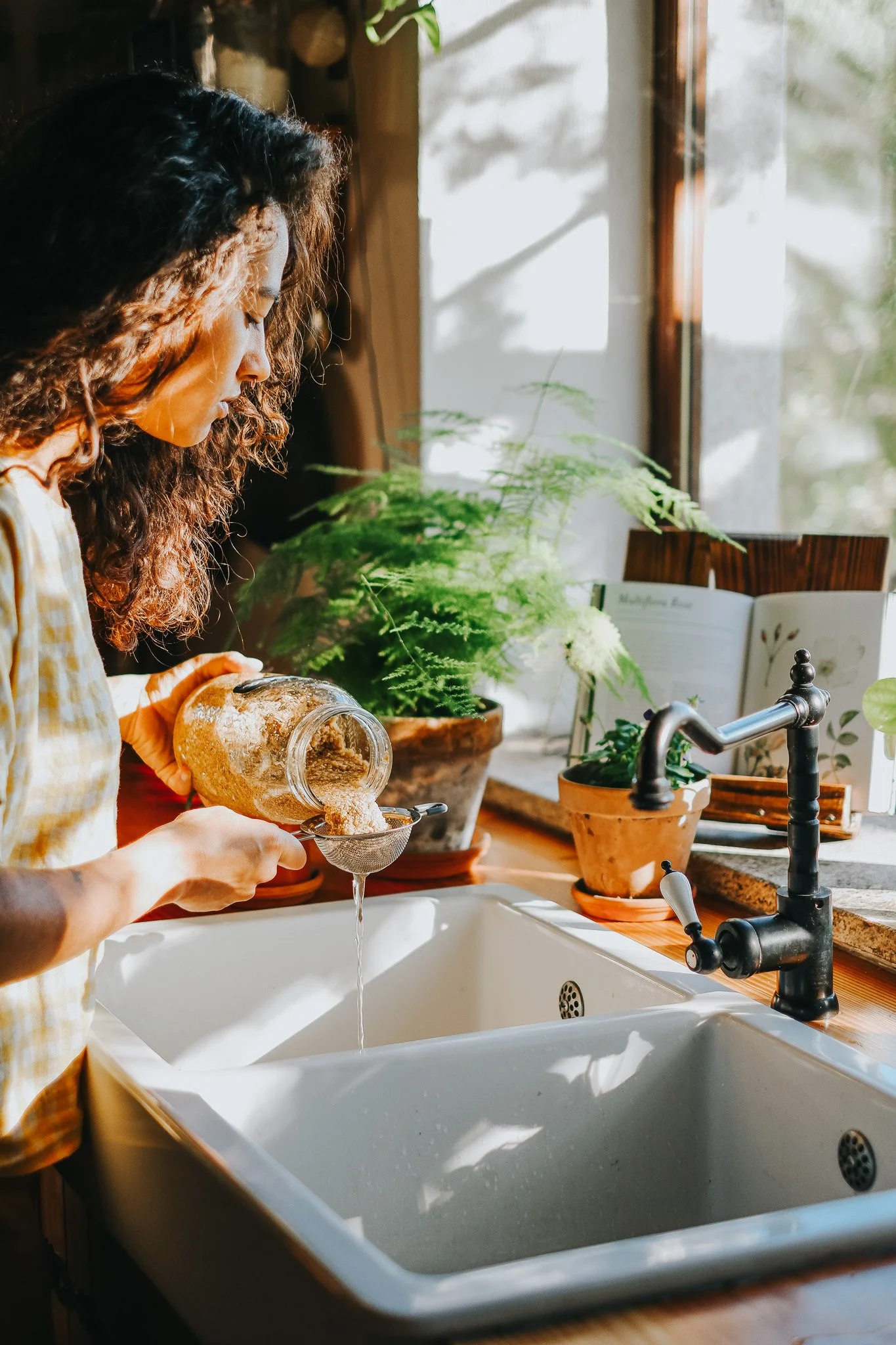


There are other processes to rinse your acorns that require less effort, depending on the resources you have available. For example, a folk method is to close your acorn pieces in a fine mesh bag and leave it well secured inside a clean stream, so the motion of running water will leach the acorns for you (similarly to how one can leach olives!)
Another method, for those who have a flush toilet, is to close the acorns in a muslin bag and leave it inside the toilet’s water reservoir, which is clean, so the motion of flushing the toilet leaches the acorns over time (and saves water, since you’re using it to flush anyway!)
Blend again & squeeze
Once your acorn pieces are no longer bitter, refill the jar with water one last time and blend them again using your immersion blender, so you break them into even smaller pieces. It should look like very coarse flour at this point.
Transfer your acorn coarse flour into the center of a muslin cloth, gather the corners, and squeeze it out over your sink, to remove as much water as possible.

Dry it out
Spread your acorns on a tray and take them outside to dry under the full sun or, alternatively, dehydrate them in the oven in the lowest setting, with the door slightly open. It takes me about 2 days to dry the flour under the full sun (bringing it inside at night), and the process will be down to a few hours using the oven method, due to higher temperatures.
Grind
Now that your acorn coarse flour is dry, you can grind it to make fine flour. I like to use a small coffee mill for this, but you can use any mill you have available (including a proper grain mill, something that’s been on my wishlist for a while!).
Store your flour
You made it! Store your flour in one, or several, tightly sealed jars. Note that acorns have a high fat content, so the flour is prone to rancidity and should be used within a year.

The recipes
Now that you have your acorn flour ready, you’re probably excited to put it to some use! Acorns have a light nutty taste and are naturally gluten-free, so the flour doesn’t behave the same way regular wheat flour does. I like to use my acorn flour by replacing up to half of the flour in a given recipe with it. Experiment!
I’ve used it in loaves of sourdough bread, vegetable burgers, and pie crusts, and there’s a lot more to try… Below are two of my favorite, true and tested, simple recipes.

Spiced acorn butter cookies
Somewhat similar to traditional butter cookies, but with the nutty profile of acorns. The addition of warming spices adds an extra layer of flavor, and these could make a holiday cookie with a foraged twist.

ingredients
225 g (1 cup) salted butter, at room temperature
55 g (1/4 cup) brown sugar
1 tsp vanilla extract
1 cup acorn flour
1 cup white wheat flour
1/2 tsp cinnamon (Cinnamomum spp.), powdered
1/2 tsp nutmeg (Myristica fragrans), powdered
1 tbsp ginger (Zingiber officinale) rhizome, powdered
1 tbsp turkey tail (Trametes versicolor) powdered extract (optional, added for a pinch of herbal magic)
directions
Cream the butter and sugar together in a bowl until fluffy.
In a separate bowl, mix the two flours with cinnamon, nutmeg, turkey tail powdered extract, nutmeg, and ginger.
Slowly incorporate this dry mix into the creamed butter and mix well, until fully combined.
Roll the dough into a log, wrap it in a piece of parchment paper, and leave it in a cold place (or your refrigerator) for about 30 minutes to harden.
Once the dough is hard, transfer it to a floured work surface and cut it into round slices using a knife.
Transfer to a prepared baking tray and bake in the oven’s middle tray at 170ºC (350º F) until they’re browning at the edges (about 12-15 mins).

Acorn pancakes
My family loves a good pancake breakfast… Anyone else can relate? These are just like normal fluffy pancakes, as acorn flour makes a food replacement for about half the quantity of regular white wheat flour. This recipe really couldn’t be any simpler!

ingredients
1 cup white wheat flour
1 cup acorn flour
2 tsp baking powder
1 1/2 cups milk
2 eggs
directions
Combine both flours in a mixing bowl. Make a small well in the center, and pour in the milk and eggs.
Mix well using a whisk or a fork.
Heat a cast iron or heavy-bottom pan over low-medium heat on the stove, and drop about 1/2 tablespoon of butter in the center. Tilt the pan so the melted butter is evenly distributed.
Ladle small portions of batter, one pancake at a time, into the center of the pan. Don’t tilt it to spread the batter — it will fluff up as it bakes. Once small bubbles start appearing on the surface, use a wooden spatula to turn the pancake over until it’s fully baked. Repeat, melting more butter in-between pancakes to keep the pan evenly greased, until no batter remains.

Still on the topic of acorns, here’s a simple Samhain ritual for tomorrow, for all who celebrate…
And some acorn links to squirrel away for further reading:
🐿️ The Acorn Culture in the Iberian Peninsula
🐿️ Acorns - As Sweet As It Gets
🐿️ Is Reintroducing Acorns into the Human Diet a Nutty Idea?
And that’s it for today, friends. I’d love to hear your acorn stories if you have some!
Be radical, eat local! ⚡